By Mike Lentz | The Mike Lentz Team - Keller Williams Realty
Yes, modestly. New Jersey foreclosure filings in the first half of 2026 were up 21 percent from a year earlier, the same pace as the nation. The state’s foreclosure rate is still less than a quarter of what it was in 2016. South Jersey has about 3.2 months of supply, and New Jersey owners hold more equity than most.
It has been nearly two decades since the 2008 housing crash, and New Jersey felt the aftermath longer than most states. The word “foreclosure” still makes people uneasy. If you are planning a move in Camden, Burlington, Gloucester, Salem, or Cumberland County, you may wonder whether more foreclosures will flood the market with homes.
Buyers may be hoping for a rush of bargains. Sellers may be bracing for more competition. The national data and our local numbers point to neither. Knowing why helps you plan your next move.
Are foreclosures rising? A modest increase from a low starting point
Completed foreclosures nationwide are up 33 percent from last year, according to ATTOM. That sounds like a big leap. Context changes how it reads.
Even with that increase, foreclosures are still about 26 percent below where they were in the first half of 2020.
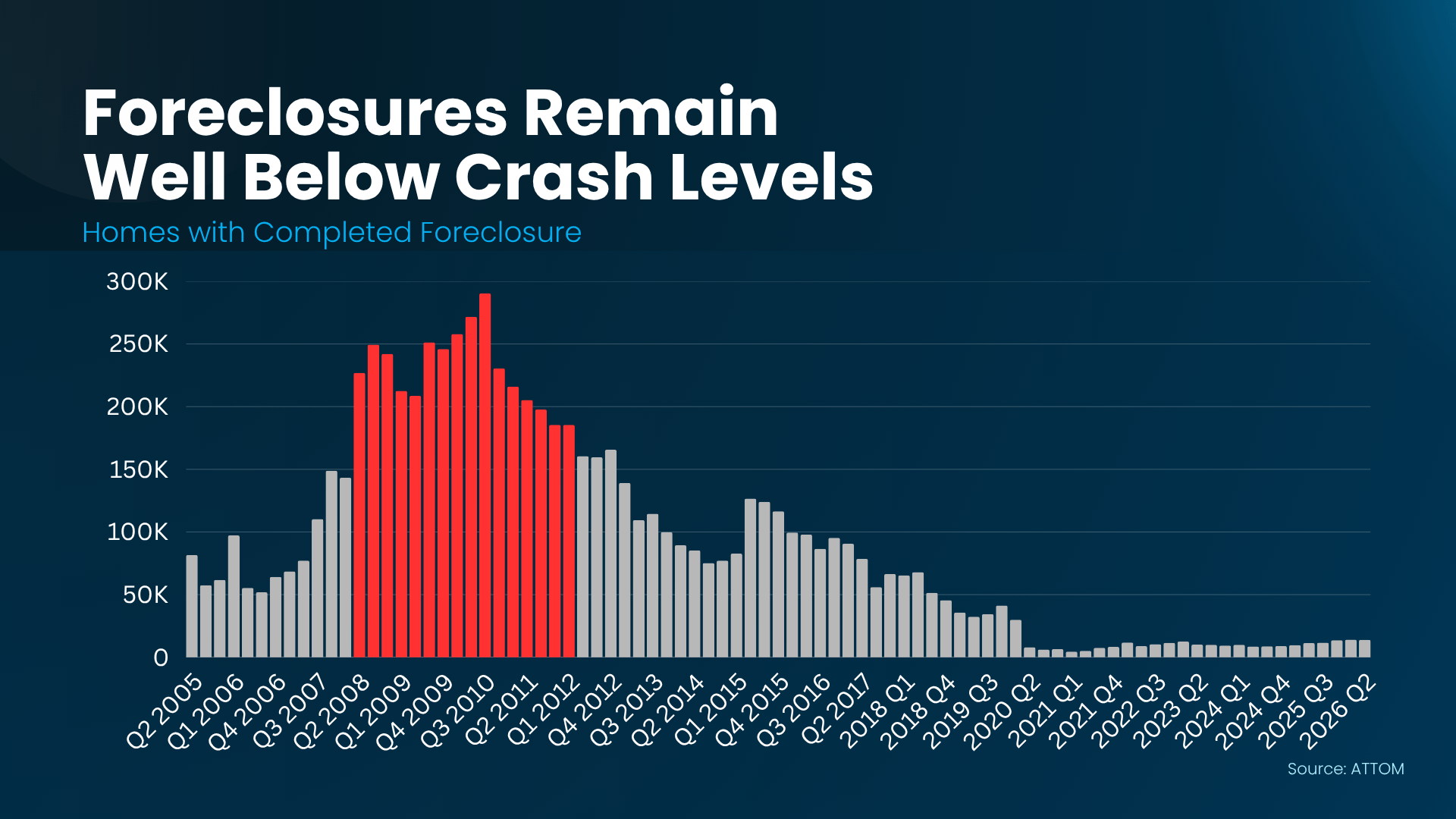
Zoom out further, and today’s activity is a small fraction of the 2008 crash. Lenders completed about 28,000 foreclosures nationwide in the first half of 2026, according to ATTOM. In the crash years, shown in red, lenders often completed more than 200,000 in a single quarter (see graph below):
As Rob Barber, CEO at ATTOM, explains:
“While some homeowners are still facing financial challenges, overall foreclosure volumes remain well below historical norms and the broader housing market continues to demonstrate resilience.”
Are foreclosures rising in New Jersey?
New Jersey handles foreclosures through the courts, and cases here take far longer to finish than in states like Texas. Because filings sit in the pipeline longer, New Jersey tends to rank high on foreclosure-rate lists even in calm years.
In the first half of 2026, 8,269 New Jersey properties had a foreclosure filing, according to ATTOM. That is 0.22 percent of housing units, or one in every 459, the seventh-highest rate in the country. Filings were up 21 percent from the first half of 2025, matching the national increase, and only about 2 percent above the first half of 2024.
The bigger story is how far New Jersey has come. In the first half of 2016, 0.98 percent of the state’s housing units had a filing. For all of 2016, New Jersey posted the highest foreclosure rate in the nation at 1.86 percent, much of it a backlog left over from the crash. Today’s first-half rate is less than a quarter of that 2016 level.
The most recent month points the same way. In August 2026, New Jersey had 1,109 properties with a filing, down 22 percent from August 2025, and the state ranked 17th.
Closer to home, ATTOM’s January report named Salem and Cumberland among the four New Jersey counties with the highest foreclosure rates. If you are shopping or selling in those two counties, that is worth knowing, and it lines up with the supply numbers below. New Jersey law also gives homeowners in foreclosure equity protections that did not exist during the last crash.
Months’ supply: balanced nationally, tighter in South Jersey
During the crash, many homeowners lost their homes to foreclosure or were forced to sell. That left the market overwhelmed with houses for sale.
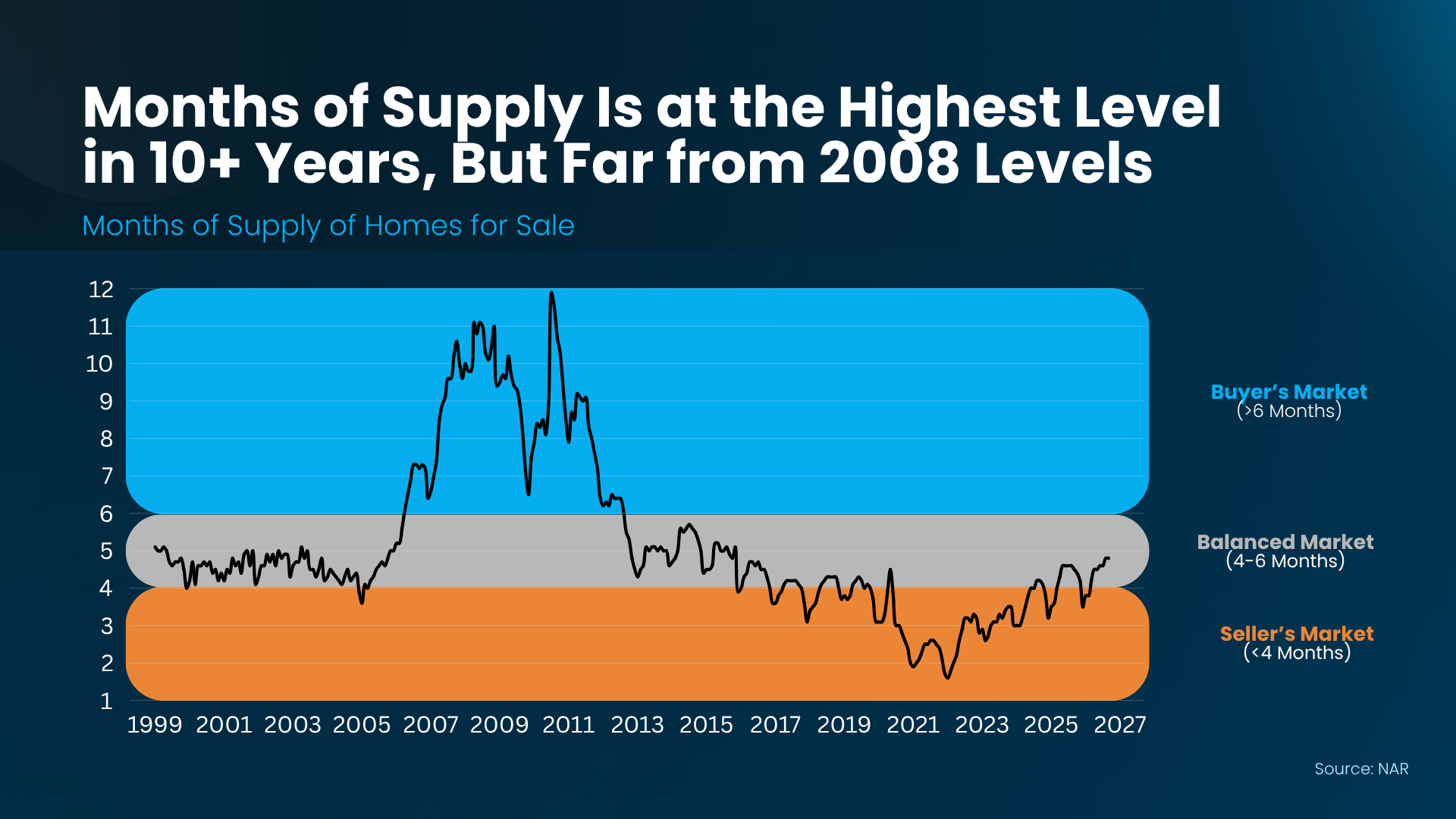
Months’ supply measures how long it would take to sell every home on the market at the current pace. Four to six months is considered balanced. We cover how to read that number in our guide to telling a buyer’s or seller’s market.
Right now, the national figure is about 4.8 months, according to the National Association of Realtors (NAR). That is well-balanced, and less than half of where it peaked around the last crash (see graph below):
New Jersey went through the same swing. The Otteau Appraisal Group measured about a 4-month supply statewide in mid-2005. By the start of 2009, unsold inventory had reached 16.9 months.
South Jersey is nowhere near that today. Across Gloucester, Camden, Burlington, and Salem counties combined, months’ supply was 3.1 in October 2026, based on Bright MLS listings and closed sales. That is up from 2.6 a year earlier and from a low of 1.0 in early 2022, but still below the 4.7 we saw in the spring of 2018 (see graph below):
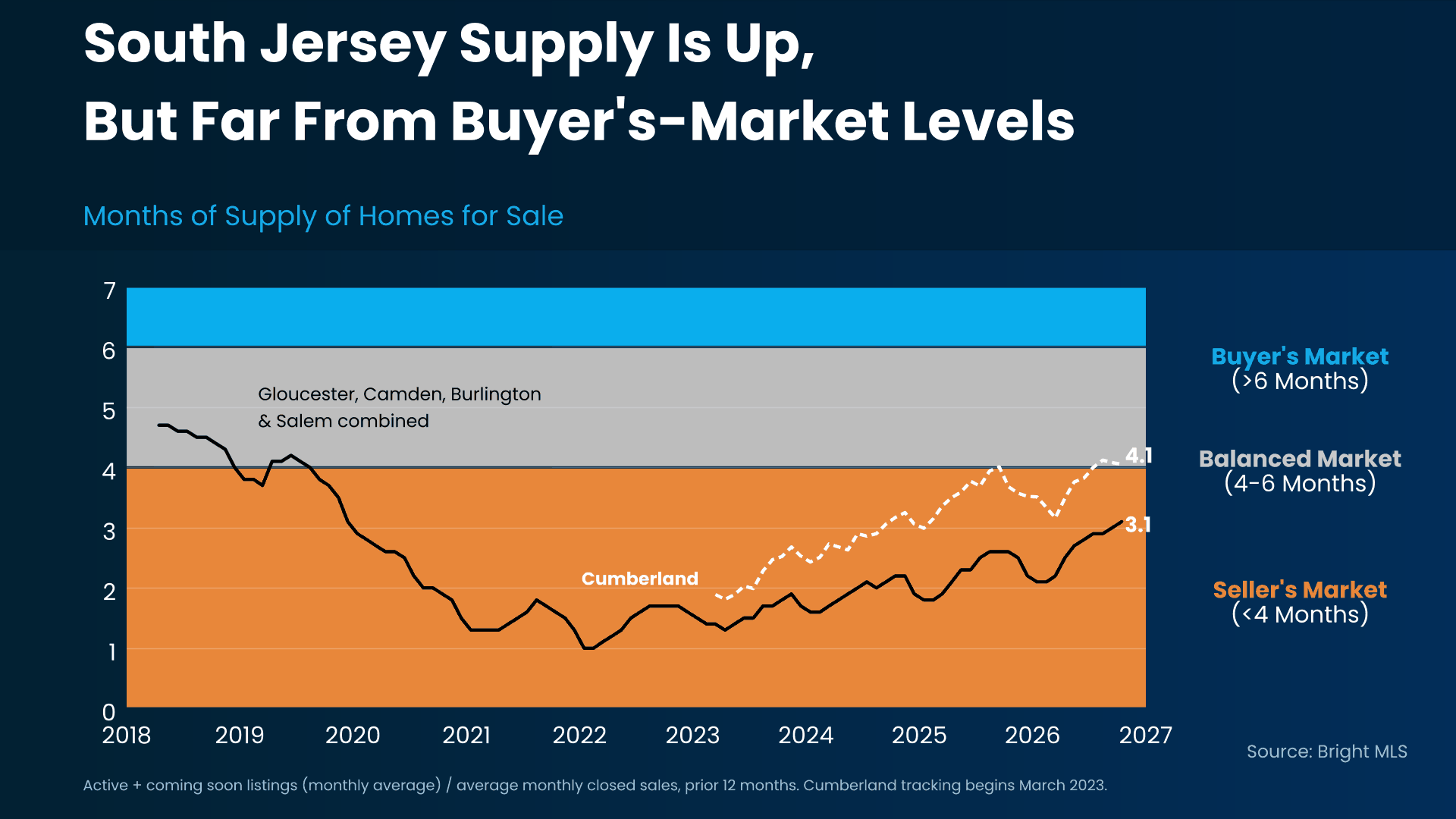
By county, Gloucester is the tightest at 2.8 months, followed by Camden and Burlington at 3.1. Cumberland (4.0) and Salem (4.2) have crossed into the balanced range, the same two counties ATTOM flagged for foreclosure activity. All five together come to 3.2 months.
So, are foreclosures rising in a way that floods inventory? The supply data says no. In October 2026, active and coming-soon listings across Gloucester, Camden, Burlington, and Salem counties averaged about 3,800, still roughly 41 percent below October 2019. As Logan Mohtashami, Lead Analyst at HousingWire, explains about the national market:
“. . . a surge of actual foreclosures in 2026 would have easily put the inventory data much higher in 2026.”
Equity gives today’s homeowners options
Equity is a big reason there is no surge of distressed sales. Data from the Census Bureau and ATTOM shows nearly two in three homeowners have paid off their mortgage or have more than 50 percent equity. Cotality says the average homeowner has about $310,000 in equity.
A homeowner with equity who hits a rough patch can usually sell the house, pay off the loan, and keep the remaining money. That option was out of reach for many people during the crash. According to HousingWire, nearly one in four homes were underwater back in 2010.
Being underwater means owing more on your mortgage than your home is worth. That makes selling much harder. Today, just 2.8 percent of homeowners nationwide are seriously underwater (see graph below):
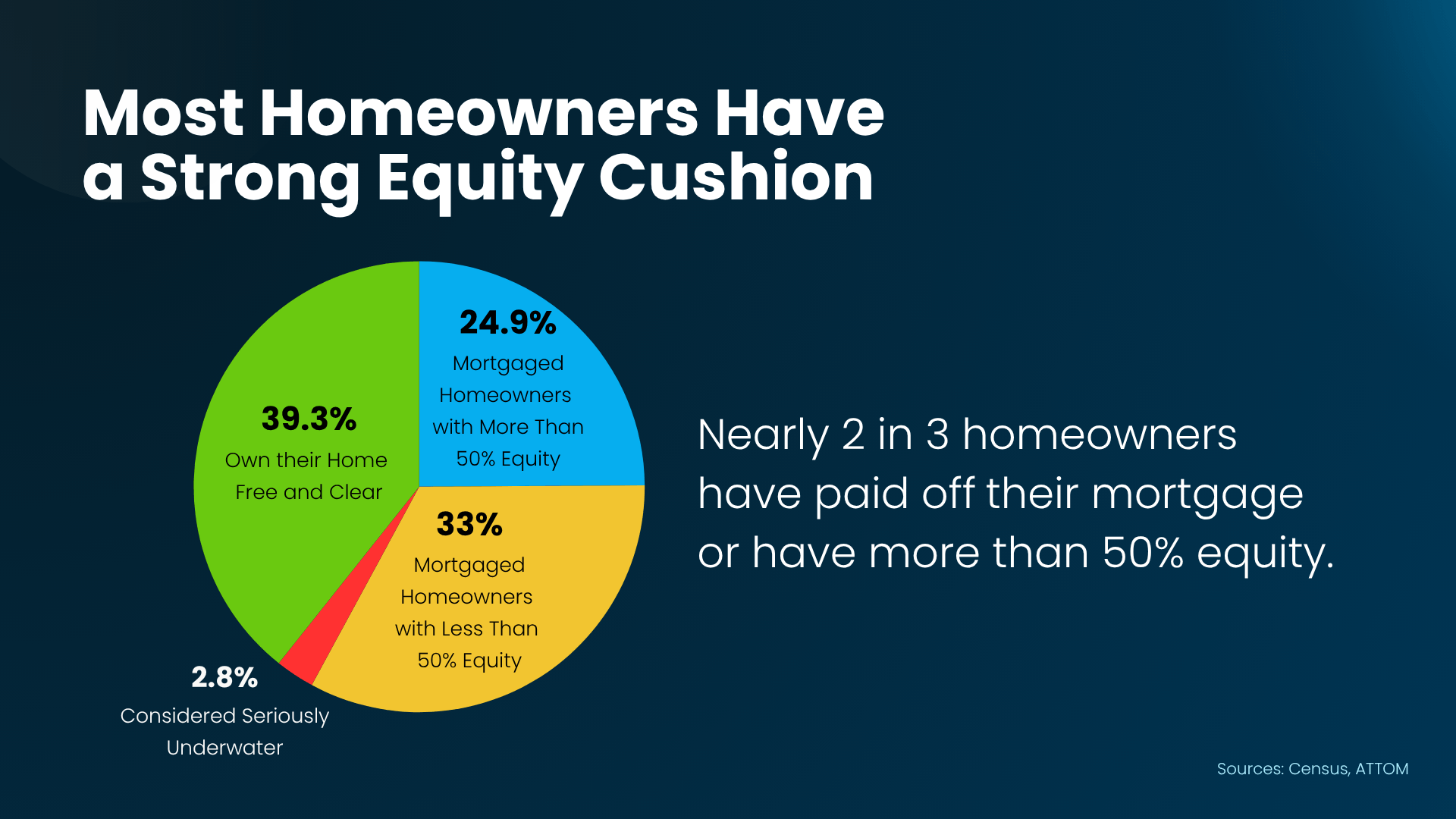
New Jersey owners are in a stronger position than the national average. In the second quarter of 2026, 51.6 percent of mortgaged New Jersey homes were equity-rich, meaning the loan balance was no more than half the home’s value. Nationally, that figure was 41.1 percent. In the first quarter, only 1.5 percent of New Jersey mortgaged homes were seriously underwater, compared with 3.2 percent nationwide.
Not every homeowner has that kind of equity. Most do, and that puts a ceiling on how high foreclosures can go. We walk through what that cushion means for the local market in why homeowner equity makes today’s market more stable.
Bottom line: are foreclosures rising enough to matter?
Foreclosures are up from last year, in New Jersey and nationally, but New Jersey’s rate is a fraction of what it was a decade ago. South Jersey still has about 3.2 months of supply, and New Jersey homeowners hold more equity than most of the country. Salem and Cumberland are the two counties to watch, and even there the supply sits in the balanced range rather than the buyer’s market range. For buyers and sellers across South Jersey, the data does not point to a wave of distressed listings.
If you want to talk through what this means for your situation, schedule a quick call and we’ll walk through the local market and your equity together.
For the full picture in your county, see our county market reports for Camden, Burlington, Gloucester, Salem, and Cumberland counties.